

SCIENCE
Science
Curriculum
-
Integrated Science 8
Integrated Science 8
8th Grade
- In this dynamic 8th grade science course, students will embark on an engaging journey through the realms of life, earth, and physical science, all while honing their scientific problem-solving skills. Through hands-on investigations and collaborative projects, students will explore fundamental concepts and key ideas that shape our understanding of the natural world. Units include: Motion and Energy, Interactions of Matter, Understanding the Universe, Earth and Geologic Change, Exploring Ecology, and Heredity and Human Body Systems.
-
Physical Science
Physical Science
8th-9th Grade
Credit: 1.0
- In this engaging high school physical science course, students will explore the fundamental principles of physics and chemistry, laying a strong foundation for future science studies. Through hands-on laboratory experiences, students will develop essential problem-solving and critical thinking skills while investigating key topics such as matter, energy, forces, and work. By connecting theoretical concepts to real-world applications, students will not only enhance their understanding of scientific principles but also prepare themselves for more advanced coursework in the sciences.
Physical Science Honors
8th-9th Grade
Credit: 1.0
- This rigorous honors physical science course challenges students to delve deeply into the fundamental principles of physics and chemistry through an inquiry-based approach. Designed for high-achieving students, the curriculum emphasizes analytical thinking and advanced problem-solving skills, fostering a comprehensive understanding of complex concepts, such as matter, energy, forces, and work. By connecting theoretical concepts to real- world applications, students will not only enhance their understanding of scientific principles but also prepare themselves for more advanced coursework in the sciences.
-
Biology
Biology I
9th-10th Grade
Credit: 1.0
- This yearlong biology course offers an in-depth exploration of core biological principles, equipping students with essential laboratory skills and fostering critical thinking. Through hands-on experiments and comprehensive studies, students will delve into key topics such as cell structure, fundamental biochemical processes, genetics, heredity, evolution, and human physiology. Emphasizing the interconnectedness of these concepts, the course aims to provide a solid foundation for future scientific studies, preparing students to approach complex biological challenges with confidence and insight.
Biology I Honors
9th-10th Grade
Credit: 1.0
- The honors biology course offers an enriched curriculum that delves deeply into advanced topics such as genetics, ecology, and molecular biology, demanding higher-level analytical skills from students. With a rigorous pace and a focus on complex concepts, this course challenges students to engage in hands-on laboratory experiments that foster critical thinking and sophisticated data analysis. In addition to scientific inquiry, students will hone their abilities in scientific communication and collaboration, equipping them with the essential skills needed for future academic pursuits and careers in the biological sciences. Through this immersive experience, students will develop a profound understanding of the interconnectedness of life, preparing them to tackle real-world scientific challenges.
Biology DE Dual Enrollment
12th Grade
Credit: 1.0
- This yearlong course is taken to earn both high school and college credit as part of the University of New Orleans dual enrollment program. Six credit hours for BIOS 1083 (Biology I) and 1073 (Biology II) are earned at the University of New Orleans upon passing both semesters. This credit is accepted at all Louisiana public universities and most out of state universities. To enroll, a student must have an ACT Composite score of 19 and a Math sub score of 19 as well as demonstrate a high level of proficiency in previous high school math courses. The first semester of this course explores the biochemistry of macromolecules, cellular structure, metabolism, reproduction and genetics. The second semester of this course explores the principles of genetics, evolution, systematics, ecology, diversity, plant growth and development, animal nutrition, development and physiology. The course uses the study features on mylabPearson to practice pre and post assessments, homework, and study tools. Exams are given on paper.
-
Chemistry
Chemistry I
10th – 11th Grade
Credit: 1.0
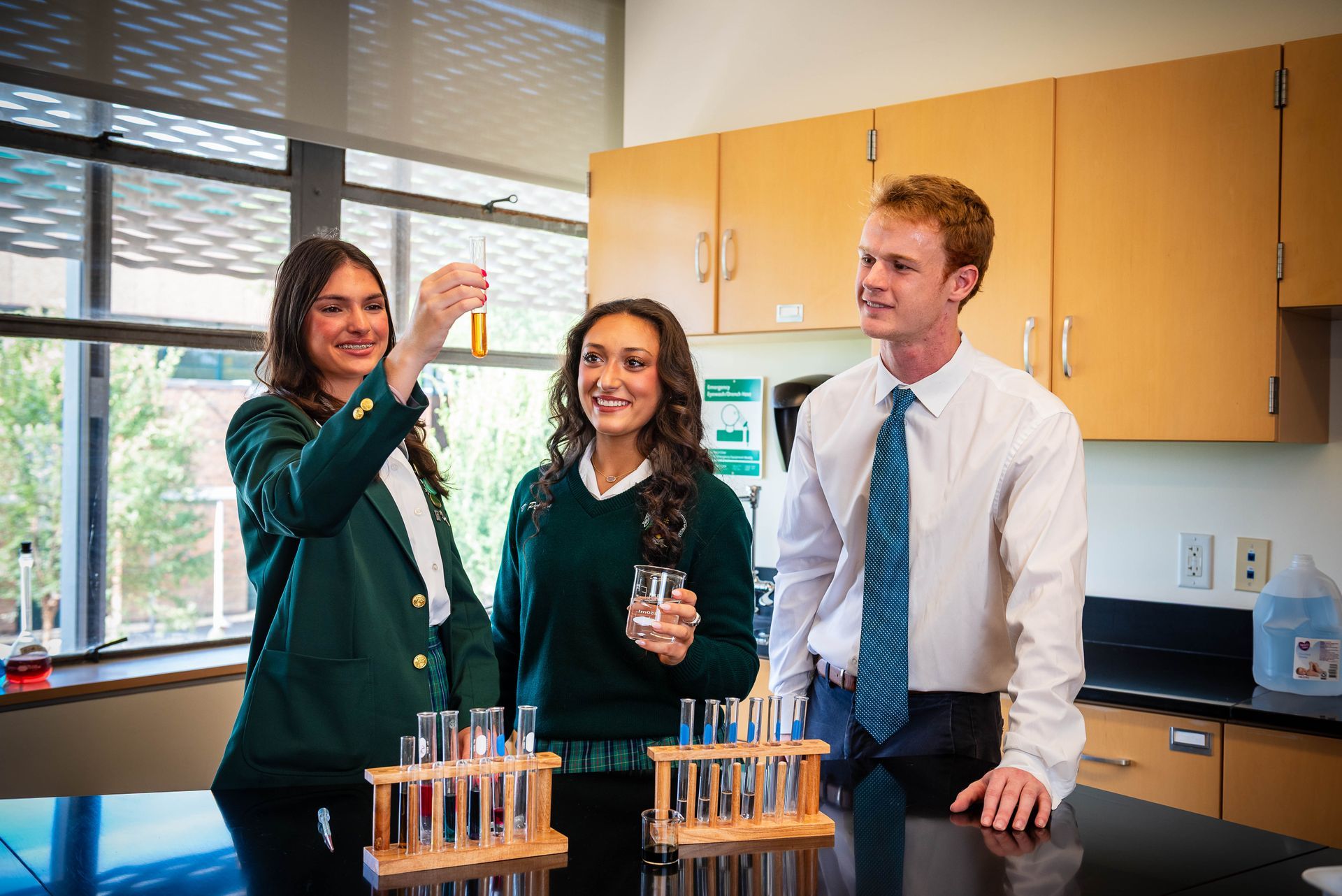
- This yearlong course explores the principles of chemistry derived as much as possible from observation and experimentation. Topics of study include atoms, molecules, chemical reactions, acids and bases, chemical equilibria, and reaction rates. Laboratory activities provide hands-on experiential learning for students to problem solve and acquire deep understanding of scientific concepts.
Chemistry I Honors
10th – 11th Grade
Credit: 1.0
- This honors-level course presents a more rigorous study of the principles of chemistry derived as much as possible from observation and experimentation. The material will be presented in greater depth in order to provide students with a deeper understanding of this science. Some of the concepts explored during the year are atoms, molecules, chemical reactions, acids and bases, chemical equilibria, and reaction rates. Laboratory activities provide hands-on experiential learning for students to problem solve and acquire deep understanding of scientific concepts.
AP Chemistry
11th-12th Grade
Credit: 1.0
- AP Chemistry is a year-long course that is an introductory college-level chemistry course. Students cultivate their understanding of chemistry through inquiry-based lab investigations as they explore the four Big Ideas: scale, proportion, and quantity; structure and properties of substances; transformations; and energy.
-
Physics
Physics
11th-12th Grade
Credit: 1.0
- This dynamic yearlong physics course invites students to explore the fascinating principles that govern the physical world. Designed to enhance understanding of everyday phenomena through the lens of physics, the curriculum integrates theoretical concepts with practical applications. Students will engage with key topics such as matter and energy, motion, sound, light, wave interactions, electrostatics, and magnetism. The course places a strong emphasis on critical thinking and problem-solving, empowering students to make meaningful connections between scientific principles and real-world experiences. With a focus on mathematical reasoning, this course encourages curiosity and fosters a deeper appreciation for the laws that shape our universe.
Physics Honors
11th-12th Grade
Credit: 1.0
- Designed to foster a deep understanding of the phenomena that shape our everyday lives, this yearlong course intertwines the fundamental laws of physics with real-world applications. This math-intensive course emphasizes the balance between theoretical concepts and practical exploration of the physical world, covering essential topics such as matter, energy, motion, sound, light, wave interactions, electrostatics, and magnetism. Students will hone their critical thinking skills as they analyze and solve complex problems, and they will develop proficiency in memorizing key formulas to apply in various contexts.
-
Environmental Science
Environmental Science
12th Grade
Credit: 1.0
- This yearlong course focuses on the study of ecology, demography, and environmental issues, such as loss of biodiversity, pollution, climate change, and resource depletion. Students will research real world environmental issues related to the course content with a special focus on the study of Louisiana's coastal ecosystem. Students enrolled in this course will also participate in LSU's Coastal Roots program, which entails growing trees in our campus nursery and planting them in areas in need of habitat restoration.
AP Environmental Science
12th Grade
Credit: 1.0
- The AP Environmental Science course is the equivalent of a one-semester, introductory college course in environmental science, through which students engage with the scientific principles, concepts and methodologies required to understand the interrelationships of the natural world. The course requires that students identify and analyze natural and human-made environmental problems, evaluate the relative risks associated with these problems, and examine alternative solutions for resolving or preventing them. Environmental science is interdisciplinary, embracing topics from geology, biology, environmental studies, environmental science, chemistry, and geography.
-
Anatomy and Physiology
Anatomy and Physiology
12th Grade
Credit: 1.0
- This yearlong course provides students with a comprehensive introduction to the structure and function of the human body. Designed for students interested in health, medicine, or the life sciences, this course covers major body systems and their interrelationships through lecture, discussion, and hands-on laboratory activities. Students will develop skills in critical thinking, scientific inquiry, and collaborative problem solving. Content is presented at an academic level with a focus on building a strong foundational understanding of human anatomy and physiology
Anatomy and Physiology Honors
12th Grade
Credit: 1.0
- This yearlong, upper-level honors course is designed for college-bound science majors seeking a degree in the area of medicine or other allied health fields. This course is an in-depth study of the human anatomy, including structure and systems, and its physiology. Students will be required to think critically, work collaboratively, and problem solve. Prerequisites include a minimum grade of B in Biology I and Chemistry I.
-
Electives
Child Growth & Development
11th-12th Grade
Credit: 0.5
- Child Development is a one-semester elective for juniors and seniors that focuses on human development from conception through early childhood. Students study prenatal development, birth, and the physical, cognitive, social, and emotional growth of children. The course examines the influence of heredity, family, culture, and environment while introducing basic caregiving skills, responsible decision-making, and career pathways in education, healthcare, and human services. Through hands-on activities and real-world examples, students will gain a deeper understanding of how early development shapes lifelong outcomes.
Food and Nutrition
9th-10th Grade
Credit: 0.5
- Food and Nutrition is an elective that will review the science behind the macronutrients that fuel our bodies and the bodily processes that digest them. As a class, we will discuss the landscape of food in the world today and how to make healthy choices in our everyday lives. The topics that will be discussed in this class include: Food Decisions, Digestion and Nutrients, The Body and Society, Physical Activity, and Nutrition throughout the lifespan. This course is meant to be highly interactive and met with great participation. Students will use critical thinking and hands-on activities to make informed decisions that can impact daily health and wellness.
Forensic Science
10th-12th Grade
Credit: 0.5
- In this hands-on course, students will step into the role of a forensic investigator and learn the real science behind solving mysteries. They will master techniques used by professional investigators: collecting fingerprints, analyzing DNA, interpreting blood spatter patterns, and examining trace evidence like hair and fibers. Ideal for students interested in criminal justice, medicine, or laboratory science, this course develops critical thinking skills and scientific reasoning while exploring the ethical responsibilities of forensic work.
Veterinary Science
10th-12th Grade
Credit: 0.5
- This semester-long course will investigate scientific concepts relating to the study of the role of a veterinarian in the care, behavior, and diagnosis of diseases in an animal. Topics to be discussed include: career exploration, veterinary terminology, anatomy and physiology, pathology, and animal management. The course will focus on dogs, cats, rabbits, birds, reptiles, and fish. Laboratory activities will provide opportunities for problem-solving through practical applications to learn scientific concepts. Application to current issues will also be explored. The class will use the resources from the student workbook from the Cornell Educational Research Program.
Meet our
Science Faculty